

Justice for "Evil Stepmothers"
I think we owe evil stepmothers a review. The fairy tales often cast the stepmother as the villain. She is vain. Jealous. Cruel. Greedy. But what if she was also trapped?
Obviously, I don’t mean all of them. Some of those women were absolutely doing too much. Like, Cinderella’s stepmother… enslavement and imprisonment is just a bit excessive.
That said, I DO think it is worth asking why so many stories needed the stepmother in the first place to understand why the evil stepmother became so prevalent.
When you look at the history underneath the trope, the evil stepmother starts to look less like a true villain and more like a woman dropped into a household, handed another woman’s children (usually when that woman died birthing one of those children, denied real power, expected to produce heirs, manage grief she did not cause, absorb resentment she did not earn, and perform unpaid domestic labor for a man who very likely remarried because he needed help.
Not love; help.
That’s where the story gets less fairy tale and starting getting very, very real.
For most of history, becoming a stepmother was not a soft-focus blended family moment with matching holiday pajamas and a court-approved co-parenting schedule. It was often the result of death, survival, property, labor, and male convenience. A mother died. The father remarried. The children stayed. A new woman entered the home and was expected to become mother, servant, nurse, housekeeper, reproductive laborer, emotional shock absorber, and family scapegoat.
The existence of previous children in this context is not neutral. In many households, that child represented inheritance, legitimacy, loyalty to the dead mother, and a claim on resources. The new wife’s future children (which she would absolutely be expected to birth at some point) would be born into competition with children who were already there and they would often lose.
The husband’s property, attention, food, land, name, and status were not abstract symbols. They were survival. Lack of these often meant that a woman and her children were at risk of starvation, exploitation, and homelessness.
Also, lest we forget, many women were not in control of if they married or who they married. Marriage was often arranged, pressured, economically necessary, or socially unavoidable. Choice, as we understand it now, was not always on the table.
What if the evil stepmother was what happened when a woman was given responsibility without authority, obligation without protection, and blame without power?
You know that pisses me of the most about this dynamic?
The father is almost always conveniently absent in these stories. Cinderella’s father either dies or becomes passive. Snow White’s father disappears into narrative fog. The children suffer, the household collapses, and somehow the woman who married into the mess becomes the face of the problem.
The man who created the conditions is treated like furniture.
Ain’t it about right that the woman takes blame for the failures or absence of a man, especially in a context where he’s supposed to be the “leader”? Well, most fairy tales were written by men, after all.
The evil stepmother became a perfect cultural container for everything patriarchy did not want to admit about men, marriage, inheritance, and domestic labor. She carried the resentment children felt toward replacement. She carried the fear of maternal death. She carried the anxiety of remarriage. She carried the threat of new heirs. She carried the rage of a household where everyone needed a woman’s labor, but she was immediately set up to receive less by being second.
Wouldn’t you be a villain too in those circumstances?
And guess what? The trope hasn’t really gone anywhere although there’s been a lot of social progress to protect women.
Men are still expecting women to carry all of the labor of raising their children and creating inequity that women have to navigate at the cost of their happiness, lifespan, and earning potential.
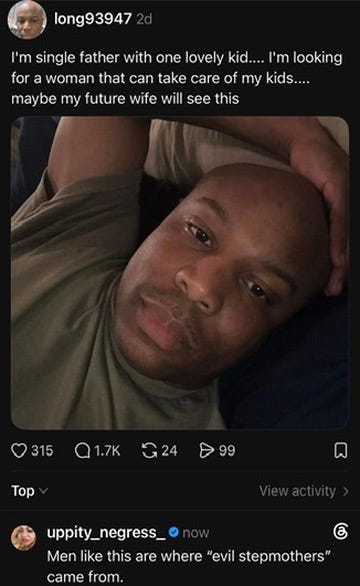
That is a bad contract.
Historically, many women did not have the luxury of refusing bad contracts. Marriage was economic survival. Domestic labor was expected. Legal independence was limited. Birthing was compulsory or close to it. Under systems like coverture, married women’s legal identities, property rights, wages, and autonomy could be absorbed into their husbands.
That is why “evil stepmother” is such a useful phrase. It lets the story skip the labor conditions.
It lets us avoid asking why a man with children needed a woman so badly.
It lets us avoid asking whether the villain was evil, or whether she was the only person in the house expected to make an impossible arrangement look natural.
That is where I want justice.
Justice means we can admit that some stepmothers were cruel while also admitting the role itself was often built inside a cruel container where it was next to impossible to “win”. Justice means we can stop pretending women invented these family conflicts out of sheer vanity and greed. Justice means we can name inheritance, property, patriarchy, unpaid labor, reproductive pressure, and male convenience as part of the story.
Justice means asking where the father was. It means asking why any of this was considered acceptable.
The evil stepmother did not become a villain because women are naturally wicked, jealous, or greedy. She became a villain because someone had to absorb the inherent flaws of a household built on women’s replacement.
I’ve stated before how Patriarchy Creates Bad Parents… of course it creates bad stepparents too.